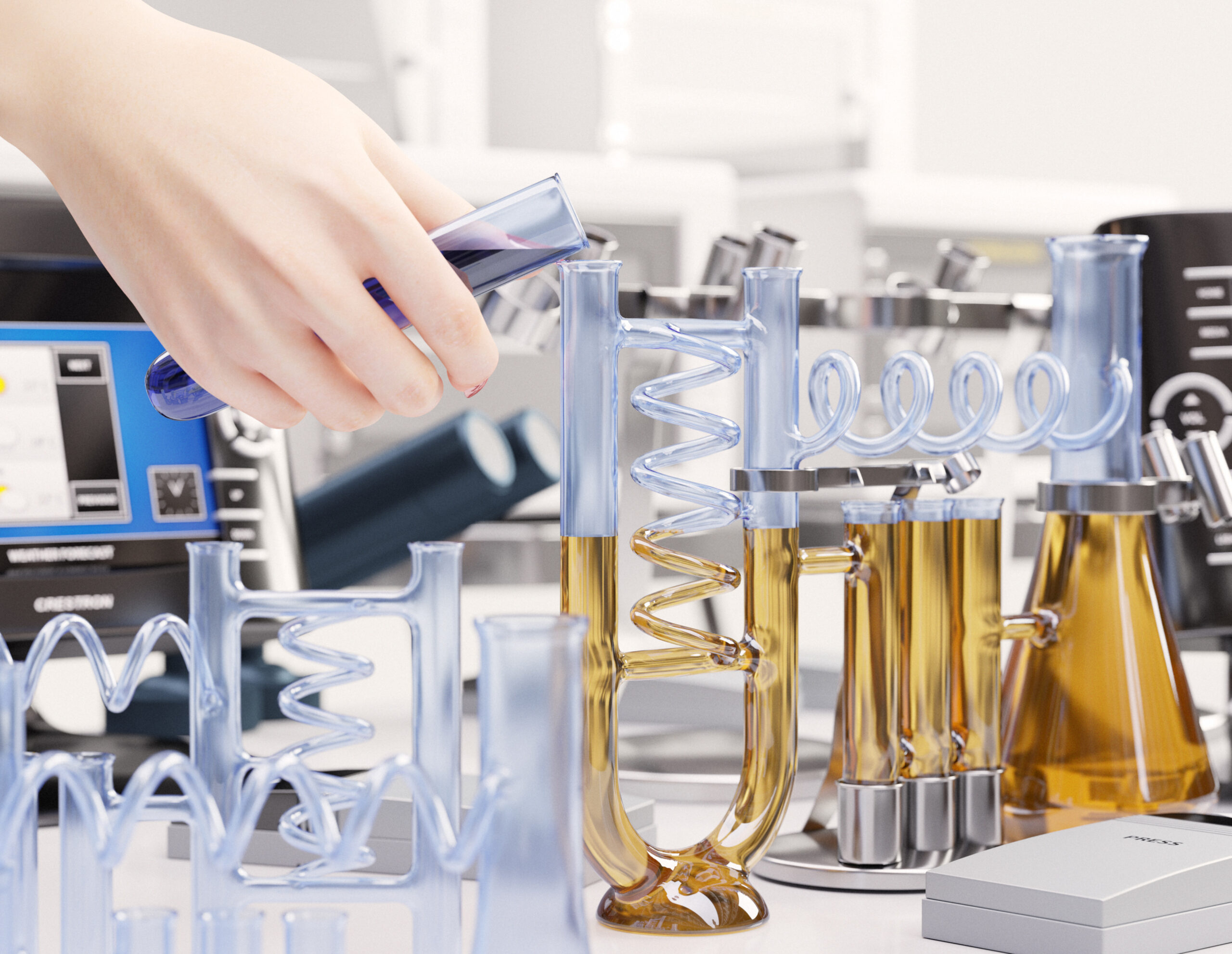
SELEX (Systematic Evolution of Ligands by EXponential enrichment) is an in vitro combinatorial chemistry technique used to isolate high-affinity, high-specificity nucleic acid ligands (aptamers) from a vast random-sequence library against a target molecule.
Think of it as “molecular evolution in a test tube.” Starting with a pool of ~10¹³-10¹⁵ random sequences, SELEX uses iterative cycles of selection and amplification to “evolve” the few molecules that bind best to the target, much like natural selection evolves organisms.
The principle is based on three repeating steps:
Incubation: A vast library of random oligonucleotides is exposed to the target.
Partitioning: The rare molecules that bind to the target are separated from the non-binders.
Amplification: The bound sequences are amplified (usually by PCR for DNA or RT-PCR for RNA) to create an enriched pool for the next selection round.
After 8-20 rounds, the pool becomes dominated by sequences with high binding affinity and specificity for the target.
A synthetic library contains 10¹³ to 10¹⁵ different single-stranded DNA or RNA molecules.
Each molecule has a central random region (20-80 nucleotides) flanked by constant primer regions for amplification.
2. Incubation & Binding:
The library is incubated with the target molecule (e.g., a protein, small molecule, cell).
Conditions (buffer, temperature, time) are controlled to influence selection pressure.
3. Partitioning (The Most Critical Step):
This step physically separates target-bound sequences from unbound ones.
Methods vary: filtration through nitrocellulose (for protein targets), affinity chromatography, magnetic bead separation, or capillary electrophoresis.
4. Elution & Recovery:
Bound sequences are dissociated from the target, often by heating, denaturing agents, or changing buffer conditions.
The recovered pool is now enriched for potential binders.
5. Amplification:
The recovered sequences are amplified by PCR (for DNA-SELEX) or RT-PCR (for RNA-SELEX).
For RNA libraries, a reverse transcription step is needed to make DNA before PCR, followed by re-transcription to RNA for the next round.
6. Iteration:
The enriched, amplified pool is used as input for the next selection round.
Stringency (e.g., wash harshness, competitor molecules) often increases with each round to select for the strongest binders.
7. Cloning & Sequencing:
After the final round, the enriched pool is cloned and individual sequences are determined.
Bioinformatics analyzes sequence families, consensus motifs, and predicted structures.
8. Characterization:
Individual aptamer candidates are synthesized and tested for:
Affinity (Equilibrium dissociation constant, Kd, often in nM-pM range).
Specificity (Binding to related targets?).
Function (Can it inhibit or modulate the target’s activity?).
To address different challenges, many advanced SELEX methods have been developed:
Counter-SELEX: Includes negative selection steps against closely related molecules (e.g., a different protein isoform) to improve specificity and cross-reactivity.
Cell-SELEX: Uses whole living cells as targets to discover aptamers for cell-surface markers in their native state, crucial for cancer cell targeting.
Capillary Electrophoresis-SELEX (CE-SELEX): Uses fast, efficient partitioning based on electrophoretic mobility shift, enabling fewer selection rounds.
Toggle-SELEX: Alternates selection between targets from different species (e.g., human and mouse protein) to generate aptamers that recognize conserved epitopes.
Genomic SELEX: Uses a library derived from genomic DNA to find natural regulatory nucleic acid elements.
Automated & High-Throughput SELEX: Uses robotics and microfluidics to miniaturize and parallelize the process, dramatically increasing speed and throughput.
High Affinity & Specificity: Comparable to monoclonal antibodies (Kd in low nM to pM range).
Chemical Synthesis: Produced in vitro, batch-to-batch consistency, no animal use.
Stability & Modifiability: Thermally stable, can be chemically modified for increased nuclease resistance or for labeling.
Small Size: Better tissue penetration than antibodies.
Target Range: Can select against toxins, non-immunogenic targets, or specific cellular states.
Therapeutics: As antagonists (e.g., Pegaptanib/Macugen® for age-related macular degeneration, the first FDA-approved aptamer drug).
Diagnostics & Biosensors (Aptasensors): As recognition elements in detection platforms for proteins, pathogens, or small molecules.
Targeted Drug Delivery: Conjugated to nanoparticles, drugs, or siRNA to direct them to specific cells.
Research Tools: For protein function inhibition, cellular imaging, or biomarker discovery.
Environmental Monitoring: Detection of contaminants like antibiotics or heavy metals.
Susceptibility to Nuclease Degradation (especially RNA): Overcome by chemical modification (e.g., 2′-F, 2′-O-methyl pyrimidines).
Rapid Renal Clearance (small size): Overcome by conjugation to PEG or cholesterol.
Complexity of the SELEX Process: Can be time-consuming and technically demanding, though automation is mitigating this.
SELEX is a powerful and versatile engine for discovering aptamers — often called “chemical antibodies.” Its strength lies in its ability to generate specific ligands against almost any target, coupled with the advantageous physicochemical properties of nucleic acids. Continuous innovations in SELEX methodology are expanding its applications in medicine, biotechnology, and analytical science, making it a cornerstone technology in molecular recognition.

Custom Peptide Synthesis Services in Mobile, Alabama | High-Purity Peptides from China Supplier KMDBioScience
Peptide Research Tuscaloosa – High-Purity Custom Peptide Supplier Serving the USA | KMD Bioscience

Custom Peptides Auburn AL – High-Quality Peptide Design & Synthesis Supplier Serving the USA | KMDbioscience

Premium Peptide Services in Auburn, Alabama – Trusted Supplier from KMDbioscience.org

Top Peptide Library Companies in AL – High-Quality Custom Peptide Libraries from China Manufacturer KMDBioscience.org
Understanding Peptide Libraries: The Fundamental Toolkit for Modern Molecular Screening
SPOT Synthesis (SPOT Peptide Synthesis) on Cellulose Membranes: A Practical Guide to Parallel Peptide Library Construction
Contract Research Organization (CRO) for Peptide Screening: A Practical, Science-First Guide to Outsourcing Peptide Discovery
Top Peptide Manufacturer Serving Alabama – High-Purity Custom Peptides from China | KMDBioScience
Peptide Screening Services for Biotech Companies in Montgomery, AL – Reliable China-Based Supplier for High-Quality Peptide Solutions
Custom Peptides AL Supplier | China Manufacturer Serving Alabama (USA) – High-Purity Peptide Synthesis for Research & Pharma
High-Quality Peptide Screening Services for Birmingham, Alabama Researchers – Reliable Supplier From China | KMD Bioscience
High-Quality Peptide Synthesis in Huntsville, AL – Reliable Manufacturer & Global Supplier from China | KMDBioscience.org
Custom Peptides Huntsville – High-Quality Peptide Synthesis Supplier from China | KMDBioScience
Premium Peptide Services in Montgomery, AL – China-Based Supplier KMD Bioscience for Custom Synthesis & Analysis
Peptide Screening Montgomery – High-Quality Custom Peptide Solutions from China-Based Supplier KMD Bioscience
Custom Peptide Synthesis Montgomery – China-Based KMDBioscience Factory Supplying High-Purity Peptides to Montgomery, USA

Top Peptide Manufacturer Supplying Mobile, AL – High-Purity Custom Peptides from China | KMDBioscience.org
Peptides Mobile Supplier for USA | High-Purity Custom Peptides from China Manufacturer – KMDBioScience.org
Peptide Screening: A Comprehensive Guide to Functional Peptide Discovery
Peptide Screening Services
Aptamer Screening Process and Applications Overview

Aptamer Screening: Current Methods and Future Trend towards Non-SELEX Approach
Analysis of Parallelized Screening Techniques for XNA Aptamers
Aptamer Screening Services for Protein
Aptamer Screening Services

Aptamer Screening Services for Multiple Targets
Toggle SELEX Services
Subtractive SELEX Services
Aptamer Analysis Services
What are Peptide Screening Services?
Aptamer Screening Services for Small Molecules
Aptamer Screening Services for Small Molecules
Aptamer Screening Services for Unpurified Protein

Aptamer Screening Services for Metal Ion
Complex Target SELEX Services
Counter SELEX Services